The claim is false because the provided evidence supports possible Japanese intervention to strengthen the yen, but does not show that the Bank of Japan invoked an "Article 589" emergency measure, prevented an imminent Monday market crash, or broadly dumped U.S. Assets to rescue Japan's economy.
False
The bank of japan just invoked emergency article 589 to prevent a market crash on monday! They're aggressively dumping U.S. Assets to save the economy.
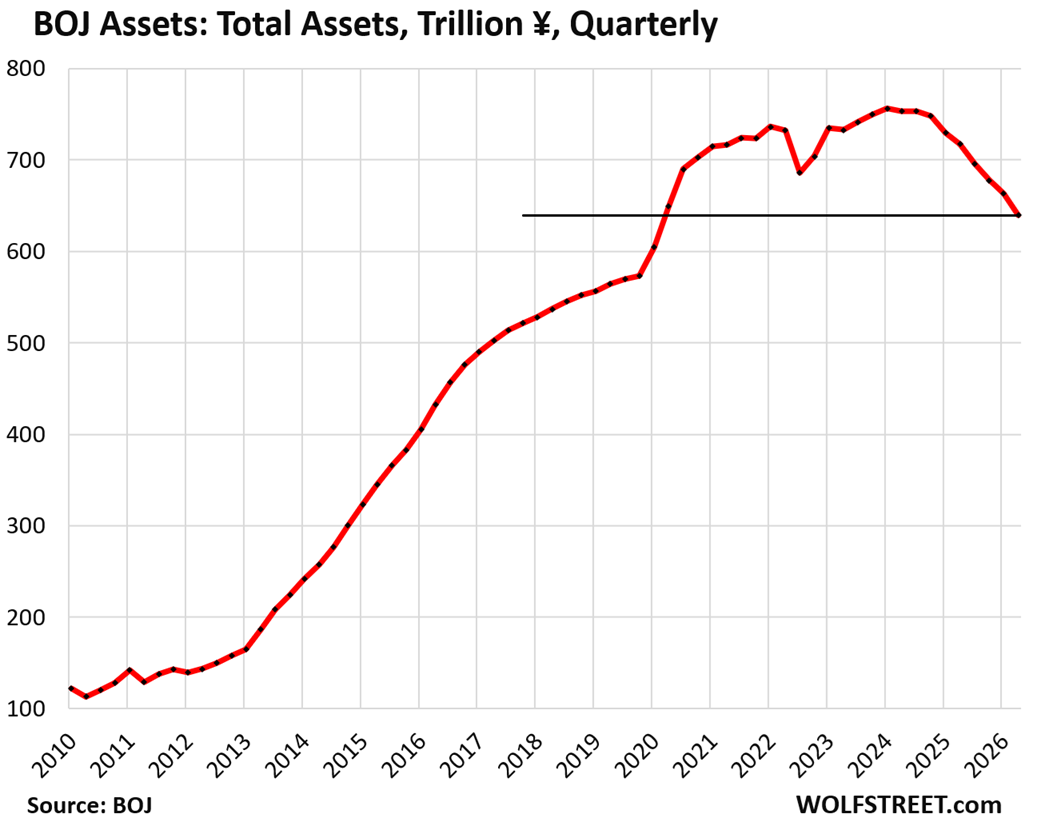
QT instead of Rate Hikes to Put a Floor under Plunging Yen: Bank of Japan Sheds 15.6% of its Massive Assets - Wolf Street
Source: wolfstreet.com
At a glance
Verified August 1, 2026Key Evidence
The strongest corroborated point is that Japanese authorities may have intervened around July 31, 2026, to support the yen; this is reported by The Japan Times and discussed in Reuters' intervention-history coverage. None of the supplied sources confirms an emergency "Article 589," an imminent Monday market crash, or a broad liquidation of U.S. Assets for the stated purpose.
The reporting
What the Evidence Shows
The statement combines a potentially real event with unsupported or exaggerated details.
• "Emergency Article 589" is unverified. The supplied reporting does not identify any Japanese law, Bank of Japan action, or official announcement involving an emergency Article 589. The only source using that wording is a YouTube Short, which provides no supporting documentation and is not corroborated by the other sources.
• Possible currency intervention is supported. The Japan Times reported on July 31, 2026, that Japan appeared to have intervened to support the yen, possibly with U.S. Assistance. A second Japan Times report described a sharp yen strengthening and said analysts considered intervention a natural explanation. Reuters also published a July 31 history of Japanese currency-market interventions. These sources support a narrower claim about possible yen-support operations, not an emergency response to an impending market collapse.
• The direction of the alleged asset sales matters. Currency intervention to support the yen generally involves selling foreign-currency holdings, often U.S. Dollars, and buying yen. That can mean selling some U.S.-dollar assets, but it is not equivalent to "aggressively dumping U.S. Assets" in order to save the Japanese economy. The available sources do not establish the scale, composition, or purpose of any such sales beyond possible exchange-rate intervention.
• No evidence establishes a Monday crash was imminent or prevented. The sources discuss yen weakness, debt concerns, quantitative tightening, and suspected intervention. They do not document a forecast or official assessment that a market crash was about to occur on Monday, nor do they demonstrate that intervention prevented one.
• Some background claims concern separate developments. Wolf Street discusses a reported reduction in Bank of Japan assets and quantitative tightening, while Fortune discusses pressure on the yen and skepticism about intervention. Those reports do not verify the alleged Article 589 action or the dramatic framing in the input.
Primary trail
Verified Sources10
Open source