Sperm and eggs are living cells but do not individually exhibit all key characteristics of independent living organisms such as growth or reproduction; they exist in a specialized, metabolically reduced state awaiting fertilization.
Mostly True
Sperm and eggs are not alive, the do not individually possess the key characteristics of living organisms. They do not develop or grow (they are in their final form so to speak), they do not reproduce (an egg can not replicate itself to create an identical egg, sperm does not replicate itself to create more sperm), and they are in a state of meiotic and metabolic dormancy, to name a few.
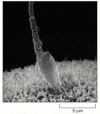
Fertilization - Molecular Biology of the Cell - NCBI Bookshelf
Source: ncbi.nlm.nih.gov
At a glance
Verified August 22, 2025Key Evidence
NCBI Bookshelf states that sperm and egg are destined to die unless fertilization occurs, indicating limited independent viability.
ncbi.nlm.nih.govncbi.nlm.nih.govFertilization - Molecular Biology of the Cell
UCSF notes sperm survival times and motility but no autonomous reproduction.
crh.ucsf.educrh.ucsf.eduHow Conception Works
Reddit biology discussions highlight that gametes do not undergo mitosis and are metabolically dormant.
reddit.comreddit.comr/askscience on Reddit: Are (human) sperm and unfertilized eggs alive?
WebMD confirms sperm are cells involved in fertilization but do not reproduce themselves.
webmd.comwebmd.comSperm: How Long Sperm Live, Sperm Count, and More
The reporting
What the Evidence Shows
Sperm and eggs are indeed cells and thus biologically alive in the sense that they possess cellular structures and metabolic activity, but they do not fulfill all criteria typically used to define an independent living organism. For example, they do not grow or develop further once mature, nor do they reproduce by themselves (no mitotic division to create more gametes).
Both gametes are haploid cells produced by meiosis and exist in a state of metabolic dormancy or reduced activity until fertilization occurs. This dormancy means their metabolic processes are limited compared to somatic cells.
Upon fertilization, the egg is activated to begin development, which supports the idea that individually, sperm and eggs are not complete organisms but rather specialized reproductive cells.
Sources emphasize that sperm can survive for limited times outside the body or within the female reproductive tract but will die without fertilization, indicating they are alive but transient.
There is some debate in popular and scientific discussions about whether gametes should be classified as 'alive' in the same way as independent organisms; however, mainstream biology classifies them as living cells with specialized functions rather than autonomous organisms.
Overall, the claim that sperm and eggs "are not alive" is misleading if interpreted strictly as non-living; they are alive as cells but do not independently meet all criteria for living organisms such as growth or reproduction. The statement correctly notes their lack of growth and reproductive ability on their own and their metabolic dormancy.
Primary trail
Verified Sources7
Open source