This claim is unverified because the available evidence consists mainly of social-media posts and secondary articles, with no cited scientific paper, institutional announcement, clinical-trial record, or independent confirmation establishing that Pilar Ferrer developed the gel or that it repairs human heart tissue.
Unverified
25-year-old Argentinian biologist Pilar Ferrer has developed an injectable gel that helps repair damaged heart tissue after a heart attack.
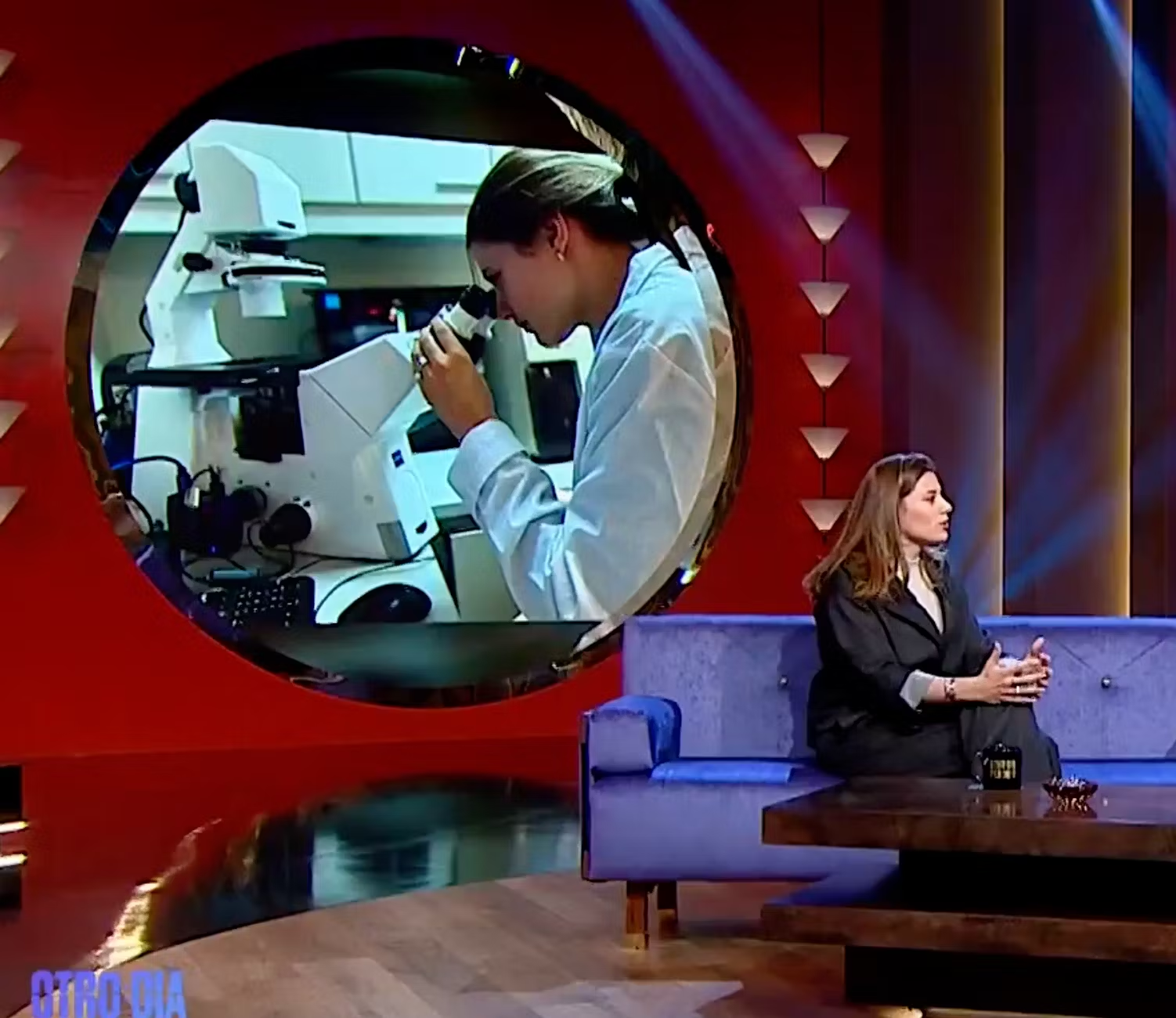
She is 25 years old, a biologist, and created a gel that repairs the heart after a heart attack using placental tissue 👀
Source: upsocl.com
At a glance
Verified August 12, 2026Key Evidence
Multiple social-media posts repeat the same claim, but repetition is not independent confirmation.
Upsocl and My Health CRM describe an amniotic- or placental-tissue-inspired scaffold, yet the supplied results do not provide primary study details or clinical evidence.
ScienceDaily documents injectable-hydrogel research from 2012, but no supplied evidence links that report to Pilar Ferrer or proves that the gel repairs human hearts.
The reporting
What the Evidence Shows
The search results repeat a similar story: Pilar Ferrer is described as a 25-year-old Argentine biologist associated with Universidad Favaloro who helped develop an injectable hydrogel inspired by amniotic or placental tissue. Some posts describe the gel as experimental and claim that it may reduce heart damage, improve cardiac function, encourage blood-vessel growth, and support regeneration of heart cells.
However, the results do not provide sufficient evidence to verify the material claims. The Facebook, Threads, X, and Reddit entries primarily repeat the assertion rather than link to identifiable primary research. The Upsocl and My Health CRM articles provide additional narrative detail, but they do not, based on the supplied excerpts, identify a peer-reviewed study, research team, laboratory, experimental model, measured results, or clinical trial.
The ScienceDaily result is not adequate confirmation of the Pilar Ferrer claim. It reports on an injectable hydrogel study published in 2012, but the supplied result does not connect that research to Ferrer, Argentina, Universidad Favaloro, or the specific amniotic-membrane-based gel described in the newer posts. It may reflect related background research or a separate hydrogel project.
The wording also appears stronger than the evidence supports. A research-stage hydrogel that shows promising results in laboratory or animal experiments would not establish that it repairs damaged heart tissue in human patients. The available material supports, at most, that an experimental regenerative-medicine project is being circulated online and may involve an injectable hydrogel. It does not verify successful human treatment or clinical effectiveness.
Primary trail
Verified Sources10
Open source